
Tough Break
A Soviet trawler, an American naval boarding party, and a 'vigorous' Canadian protest

In 2025, I published The Next War, a history of American-British-Canadian (ABC) intelligence relationships, and especially the creation and operation of the Tripartite Intelligence Alerts Agreement (TIAA).
The TIAA was an agreement between Ottawa, London, and Washington to warn each other immediately if they thought the Cold War was going to turn hot. In the first decades of this agreement’s existence, the actual mechanism for warning each other required sending special messages via a transatlantic cable network — great big cables that ran under the sea.
The three capitals had checklists of critical indicators they would look to judge whether some Soviet action was a signal that war was about to begin.
It only made sense that if the Soviet Union was going to begin World War III, the Soviets would take steps to try and sever this communication system. And so disruption of this undersea cable network was considered an indicator that war might be imminent.
And sure enough, in 1959, several undersea cables were broken. The Alerts system scrambled into action, to allow the intelligence communities in Ottawa, London and Washington to determine whether this indicated a coming crisis.
I told this story, briefly, in Chapter 6 of The Next War.
But we know there was another dimension to this incident.
After my book was published, the Government of Canada responded to outstanding ATI requests and released more information about this crisis. This gives us a few more details about the operation of the TIAA.
But more important, it reveals a serious disagreement between the Americans, on one hand, and the Canadians and the British on the other, over actions taken by the Americans after the cable breaks were discovered.
Of course, in an ideal world, Library and Archives Canada would have responded to my access request in time for me to include these details in my book. Still, I have the opportunity to provide the update here, so here’s the story:
Intelligence Agreement
In late February 1959, AT&T, which maintained the undersea cables, realized several had been broken. The company sent out its own airplane, which observed a trawler in the vicinity of the cuts. The trawler had “hammer and sickle markings.”
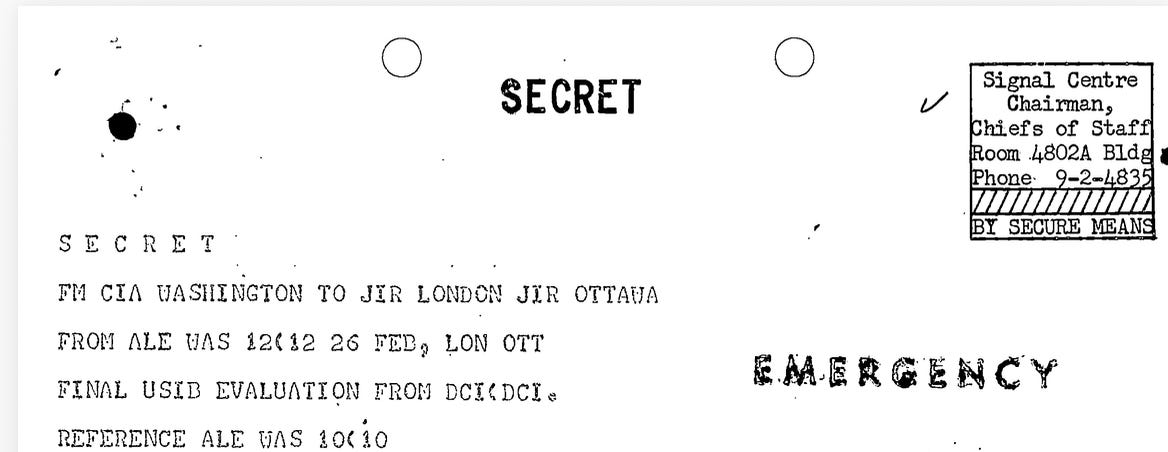
After AT&T told the U.S. government, the CIA invoked the Tripartite Intelligence Alerts Agreement by sending a special alert message to Ottawa and London.
Ottawa did not have much information to go on, and could not determine if this was a deliberate act. If this was a deliberate Soviet act to sever the cables, however, Ottawa “would regard these acts as a critical indicator” — that is, a real warning of impending crisis.
In the next couple of days, the CIA concluded that the cuts were not an indication of the “imminence of hostilities.” If the Soviets had started jamming alternate radio circuits, essentially trying to cut off military message traffic between North America and Europe, this would have been a different story.
The CIA did not rule out that the Soviet trawler had broken the cable on purpose: it was possible the “result of fishing or a ‘fishing’ expedition”. That is to say the Soviets might have been just dragging their fishing gear, or maybe dragging it in hopes of finding some cables along the way.
The Canadians (and the British) accepted this. The three parties did begin studies on the vulnerability of these cables.
But this is the intelligence side of the story. What happened next, and what I did not know, was a U.S.-Canadian squabble over naval action in response to the breaks.
Policy Differences
United States Navy and Royal Canadian Navy destroyers were both ordered to the general area where the cables were cut.
It turns out one of the U.S. warships had even more explicit instructions:
On the day of the CIA’s first TIAA message, the Chief of Naval Operations (the top U.S. naval commander) directed the destroyer USS Hale to intercept the Soviet trawler Novorossirsk suspected of damaging the cables. The Hale was to stop and board the Soviet ship.
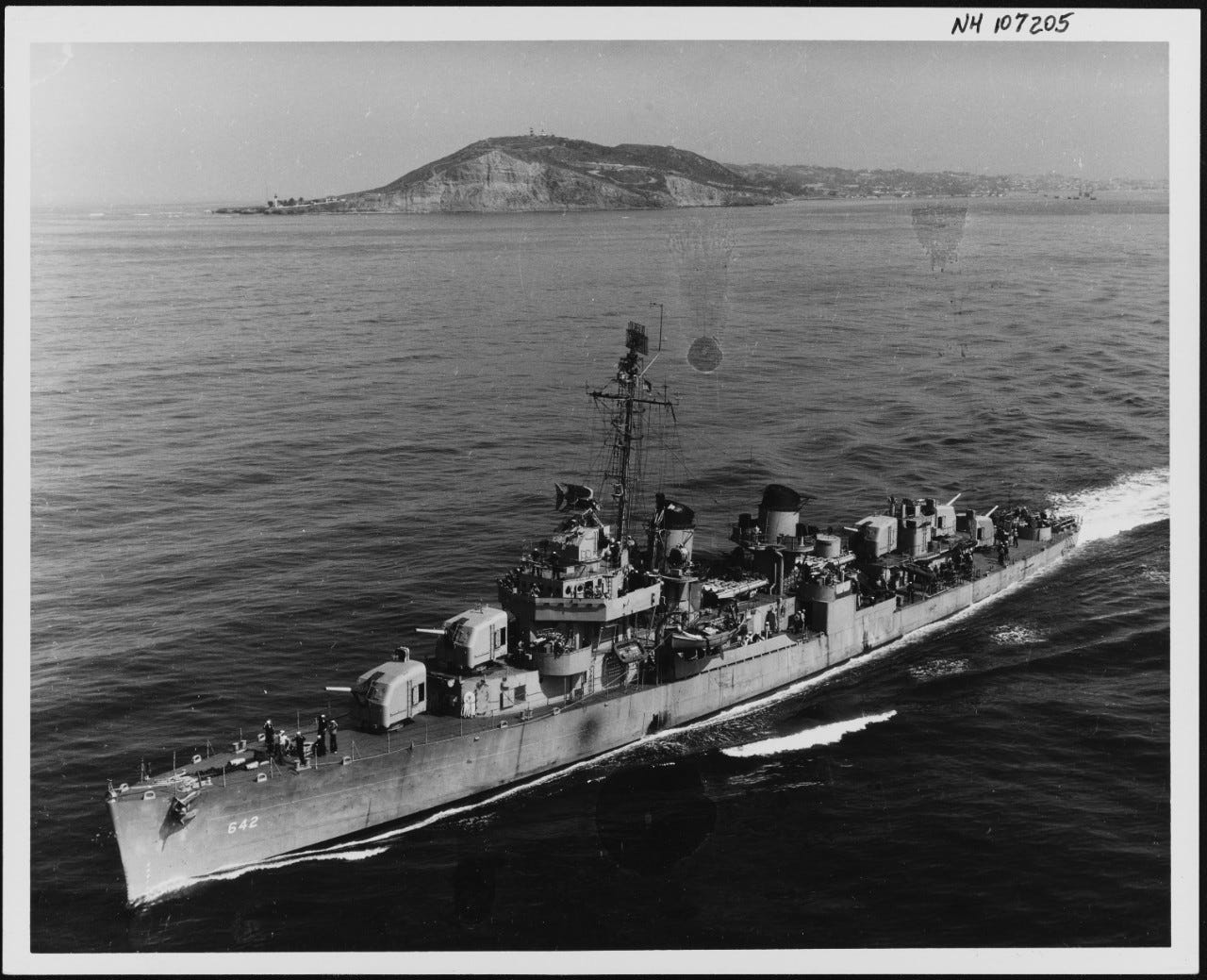
The U.S. justification for such an action was an 1884 convention regarding the protection of submarine cables that had been signed by both the United States and Russia. The American boarding party had instructions to learn what it could about the equipment aboard the Soviet ship and discover the “real nature” of the ship’s mission.
Canadian civilian leaders — both officials in External Affair, the Prime Minister, John Diefenbaker, and the Secretary of State for External Affairs, Sidney Smith, were shocked by this order and wanted it rescinded. (A telegram describes the Canadian reaction as “very disturbed” — which sounds pretty anodyne, I know, but is indeed strong language for a telegram.)
In 1959, Canada had its embassy and ambassador, as well as uniformed service representatives in Washington. Both tried to convince the Americans not to board the Soviet trawler.
The Chief of Naval Staff in Ottawa instructed Canada’s top naval officer in Washington to ask the Americans to rescind their boarding order. No luck.
At the same time, Canada’s ambassador was “urgently instructed … to impress on United States authorities how unwise, in our opinion, it would be for the Soviet trawler to be boarded by the United States Navy.” (This was urgent enough for a telephone call from Ottawa to Washington.)
The task fell to Arnold Heeney, Canada’s ambassador, to meet with Livingston “Livy” Merchant, an American diplomat at the State Department. The two met and had what must have been quite a row — Heeney “expressed his view in vigorous terms” and told Merchant that the American action was “inappropriate and unwise.” (Again, you’ll have to take my word for it, but these are carefully chosen words that suggest a testy meeting!)
The discussion between Heeney and Merchant led America’s top diplomat, acting Secretary of State Christian Herter, to call Sidney Smith and tell him that the State Department “was not disposed to recommend” the boarding order be countermanded. They had the right to do it under the 1884 convention. And they would do it.
Diefenbaker was kept in the loop during the crisis. When he learned about Herter’s call — that is, when he learned the U.S. would not back down, Diefenbaker himself instructed that the Canadian destroyers should not meet up with the Americans as planned. They instead returned to St. John’s.
The Americans boarded the ship. They found it “equipped for deep-sea fishing and all papers were in order.” The Master of the trawler was “friendly and cooperative, and there were no indications other than fishing.” Its logbook showed it had been working in the area of the cable breaks.
It is not that the Canadians wanted to ignore the incident. In Ottawa, they called in the Soviet chargé to explain Canada’s concern about the negligence of the Soviet trawler during this “accident incidental to fishing operations.” They were warning the Soviets, delicately, that this was a problem.
But the Americans simply saw things differently. Merchant said that the U.S. took the incident seriously and thought the U.S. and its allies “should react promptly and firmly.”
Still, Merchant had no more evidence than the Canadians that this was a deliberate Soviet action. The problem here, and something that Heeney remarked on in writing to Ottawa, is that this was not a case of the Americans and Canadians coming to different conclusions based on different information. It appeared that both the “naval and intelligence agencies” of Canada and the United States were working from the same facts, and there was agreement at this level on the nature of the cable break.
What differed was the actions and views of the respective governments — Ottawa and Washington had the same facts, but disagreed on what to do.
The Canadians clearly thought the American actions here, as in Skyhawk later in the year, but also in other crises of the era, was unnecessarily provocative and dangerous. Heeney seems to have some parting shots for Merchant about how the U.S. was conducting its international affairs.
If I had this information at the time of my book, I would have reflected on how this successful use of the Tripartite Intelligence Alerts Agreement led the Canadians and Americans to quickly exchange information and come to an agreement in terms of their analytic judgment of this incident — but that that shared intelligence appreciation did not prevent the two countries from taking very different actions.
All of the documents from the release package are now available on Canada Declassified. The LAC ATI Request number is A-2023-01277 and the original archival folder is RG 25/R219, BAN 2017-00434-0, Box 39, file 6-7/54-1, “Alerts – Transatlantic Cable, Cutting of,” Part 1, Library and Archives Canada. By the way, this is one of the LAC files that you cannot find on LAC’s online catalogue. The Canadian Foreign Intelligence History Project has a number of finding aids with details regarding files that cannot yet be found in online catalogues. Get started here: Research Guide to Records on foreign intelligence in Canada (1945-2000)
All quotes above are drawn from the following documents: CDIW02449; CDIW02450; CDIW02452; CDIW02457; CDIW02458; CDIW02460; CDIW02461. You can search for these documents by their identifier number, using the little magnifying glass at the top of the Canada Declassified.
Updates:
Readers of Canada Declassified will recall some excellent posts and other scholarship by Sam Eberlee. Sam defended his terrific dissertation this week — he’s now Dr. Eberlee. His committee thought his dissertation, “Canada’s Joint Intelligence Bureau and the Cold War World, 1945-1968,” an outstanding model of research and writing. Congratulations, Sam!
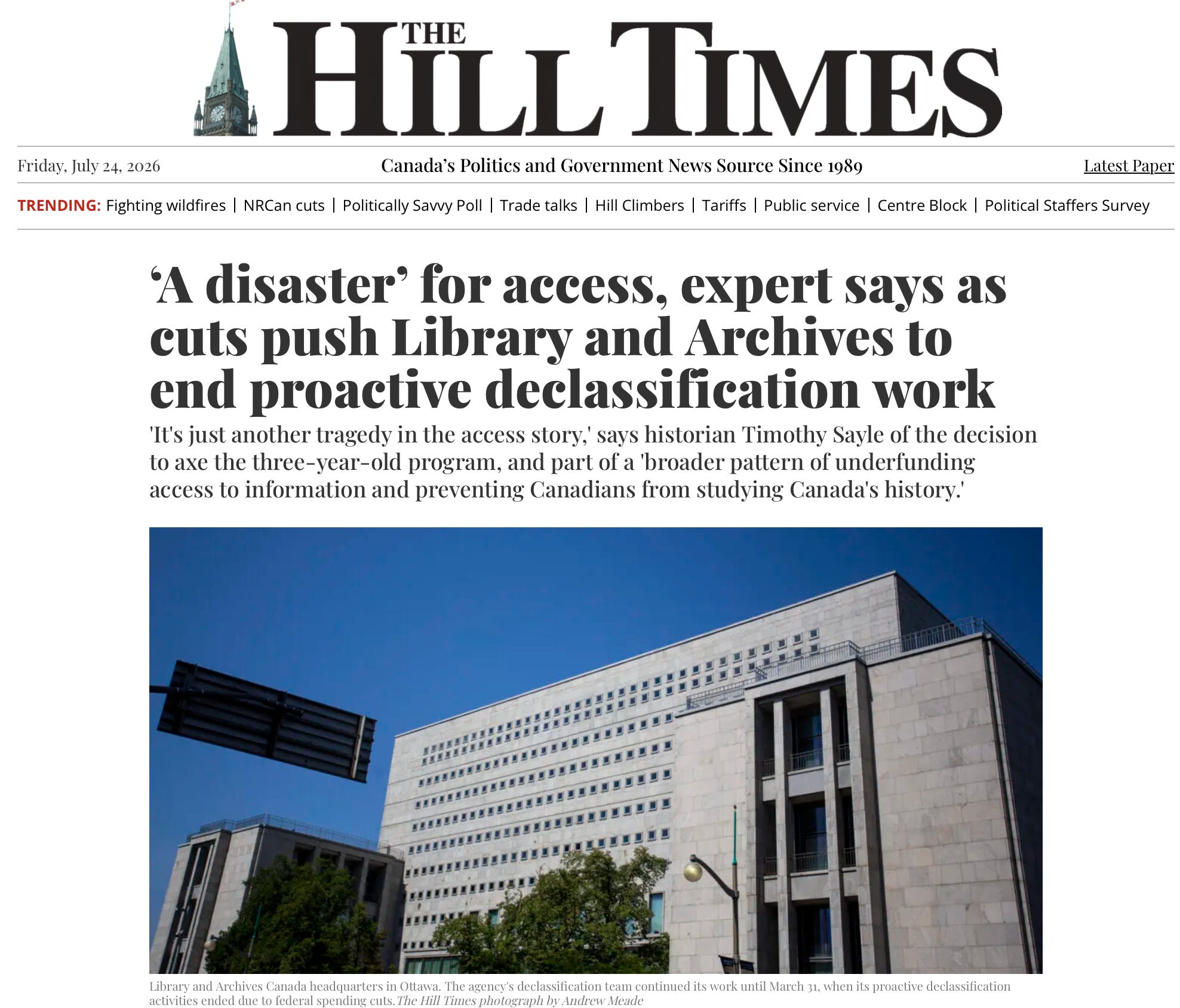
It seems like another blow of the axe has fallen on Library and Archives Canada, and LAC’s declassification team has been disbanded. I commented on the cuts in The Hill Times.
Fascinating tale Tim, especially as we now know the Cuban Missile Crisis just a couple of years later. Agreed it would have been better if the documents had been released in a more timely fashion.
I'm curious as to how the it transpired from there: did the Americans board the Soviet trawler? If so, what was the reaction? (Clearly not the nuclear conflagration feared by Canada.) But if not, was it due the GoC intervention? And you note Diefenbaker, but what was the stance of then-POTUS Eisenhower?
Keep up the great work!